
The copyright page is probably one of the most missed parts of any professionally published book. It is usually just a short note at the beginning of the book, but contains a ton of useful publishing and legal info. This allows both writers, publishers, and self-published authors to protect their intellectual property and be clear about their publication rights. If the copyright page is set up properly, it will inform readers and publishing platforms who owns the work, how it can be shared and what the legal disclaimers will be. The copyright page is one of the first things readers see in a book. If the copyright page in a book is not formatted properly, the book could appear as though it were unfinished or displayed amateurish publishing practices.
If authors know how to create a copyright page, they can be confident that their work is legitimate and done according to the laws of their country. If authors follow the proper guidelines for professional publishing when creating their copyright page, they can be confident that their work is safe and meets industry standards.
What Is a Copyright Page?
A copyright page is a section located in the front matter of a book that provides legal and publishing details. It typically appears on the back of the title page and contains essential copyright and publication information. The purpose of this page is to establish intellectual property ownership and clarify how the content may be used. Providing correct publication information will assist consumers, retailers, and libraries in identifying a book accurately.
Accurate copyright information is required in order to submit both print and electronic books to publishing platforms, such as Amazon’s Kindle Direct Publishing. Having a properly formatted copyright page is essential to ensure that these submissions meet various publishing standards.
Why a Copyright Page Is Important
It is a common misconception among writers that just by writing a book, their work is automatically protected. In many cases this is the case where an author is guaranteed copyright protection upon creation; however, obtaining formal documentation regarding the author’s copyright gives the author more definite acknowledgment of ownership rights to their creation.
A copyright page serves several important purposes.
- First, it establishes legal ownership of the content.
- It also provides publishers and readers with information on usage permissions.
- Third, it presents the book in a professional publishing format.
Books released without this section may appear incomplete or unpolished to industry professionals.
Key Elements of a Copyright Page
A professional copyright page contains several standard elements that appear in most published books. The exact structure may vary depending on the publishing method or distribution platform, such as traditional publishing, self-publishing, or digital distribution, which can influence the specific elements included on the copyright page.
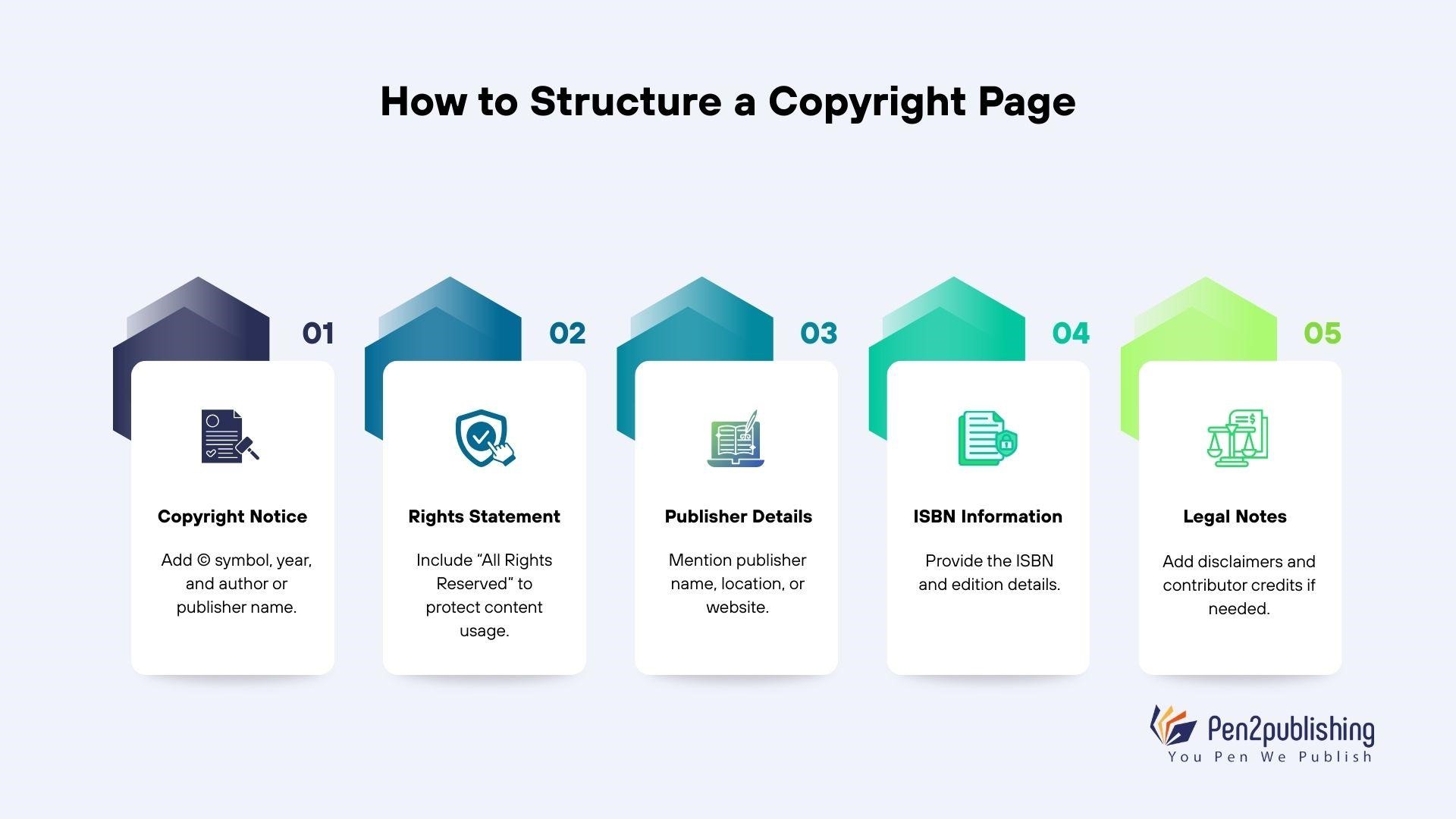
Copyright Notice
The copyright notice is the core element of the page.
It usually includes the copyright symbol, the year of publication, and the name of the copyright holder.
Example:
Copyright © 2025 by Author Name
This line formally states who owns the intellectual property rights to the book.
Rights Statement
The rights statement details the ways in which the book may be utilized or reproduced. Books generally have the phrase “all rights reserved” printed within their pages to signify that any usage will require permission from the author/publisher(s), as indicated by that statement. One common statement says that no portion of the book may be reproduced without first obtaining the author/publisher’s written consent. This data protects the work from any form of copying or distribution without permission.
Author and Publisher Information
You may find both the name and address of the publisher listed on the copyright page. This information helps identify who produced the book and who holds publishing rights. Self-published authors frequently list their independent publishing imprint on this page.
ISBN Information
The International Standard Book Number, commonly known as ISBN, uniquely identifies a book edition. Each format of a book, such as paperback, hardcover, and ebook, typically receives a different ISBN. Including the ISBN number will help bookstores, libraries, and other distributors correctly catalog the book.
Disclaimer Statements
Certain books contain disclaimers that define the type of content contained within them. For instance, most works of fiction include statements that say the characters are made up. A common disclaimer would be, “Any coincidence is coincidental.” Some nonfiction books provide liability disclaimers concerning the advice that they give or the professional knowledge contained in their work. Such disclaimers state that the author(s) will not be held liable for results created by using the information they provide.
Edition and Publication Information
Many books include details about the edition or printing history. This information indicates whether the book is a first edition, revised edition, or later printing. Including this data helps readers and collectors identify different versions of the book.
The copyright page is located in the front matter section of a book.
The copyright page is part of the book’s front matter section. It usually appears immediately after the title page. Front matter is generally organized using the below order:
- Title page
- Copyright page
- Dedication page
- Table of contents
Keeping this organizing structure will help align the book to publish professionally.
Copyright Page Templates for Authors
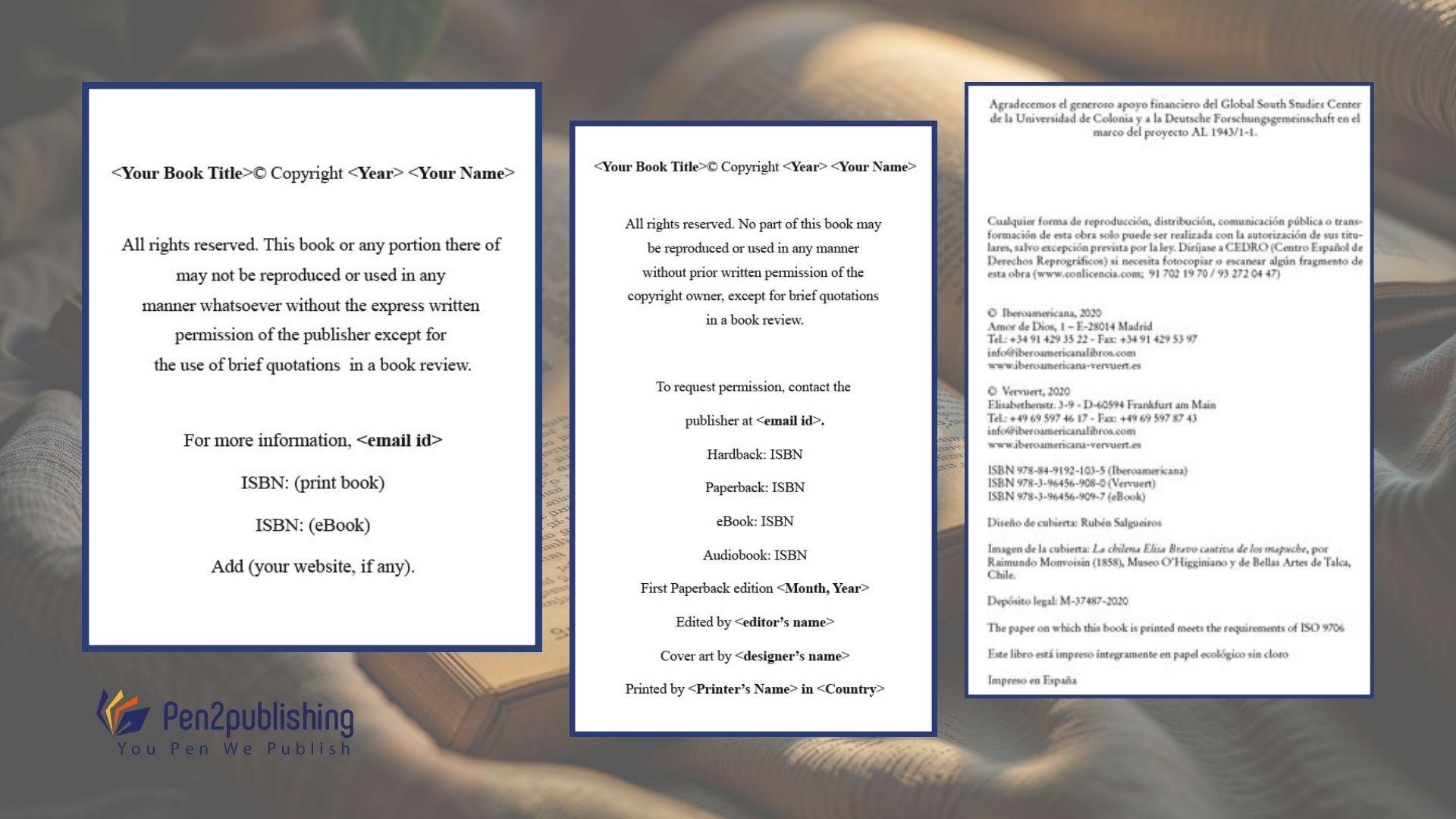
Creating a copyright page becomes easier when authors follow a basic template.
Here is a simple example structure.
Copyright © [Year] by [Author Name]
All rights reserved.
No part of this publication may be reproduced or distributed without written permission from the author.
Published by [Publisher Name]
ISBN: [ISBN Number]
Disclaimer: This book is a work of fiction. Any resemblance to real individuals is coincidental.
Printed in [Country]
Authors may customize this structure based on their book’s needs.
Copyright Pages for Self-Published Books
The majority of self-publishing authors create their copyright pages without assistance. While it is a relatively easy process, ensuring the accuracy and proper format of one’s copyright page is crucial. A self-published book must have all of the same characteristics as a traditionally published book, including copyright notice, ISBN, and all publishing company information to comply with industry guidelines. Although readers may not always see a copyright page immediately, professionals in publishing will! A well-structured and clearly written copyright page clearly communicates attention to detail and professionalism.
Copyright Page Differences for eBooks
Digital books follow the same copyright principles as print books. However, ebook formatting may require slight adjustments. The copyright page of an ebook is located after the title page in the digital file. While all of the information is consistent between the two pages, additional spacing and formatting may be added or deleted depending on how the ebooks will be displayed across various digital devices. Ensuring that the ebook’s copyright page looks good on every size of screen will provide a professional appearance.
Common Mistakes Authors Should Avoid
Copyright pages may be unintentionally created by many authors with incorrect or incomplete data. One of the most common errors is forgetting to put in either the year of publication or the copyright symbol. Other errors include leaving off either the ISBN or the correct edition of the work. Additionally, other authors will use a template and fail to make the template their own by changing the title/ name of their book, etc. These types of errors may create inaccurate legal statements. Therefore, all authors should carefully review their copyright page prior to publication to prevent making these mistakes.
How Professional Publishing Services Help
You wouldn’t think it would be hard to create a copyright page but there may still be mistakes made while publishing. Authors can rely on professional publishing services to establish proper structure for all writing elements. Professionals are knowledgeable about the technical specifications for modern book distribution methods as well as understanding how to format copyright information according to both print and digital formats.
Partnering with experienced publishers allows authors more time to correct any potential publishing mistakes and to ensure that their copyright information is correctly formatted for both print/digital versions.
The Role of a Book Copyright Page
A copyright page may seem like a small component of a book, but its importance should never be underestimated. This section establishes ownership, protects intellectual property, and ensures that the book meets professional publishing standards. Authors who include a well-organized copyright page boost their credibility and protect their creative work. Writers can easily make a professional copyright page by knowing the basic parts and following templates that are already in use.
FAQs
1. What should be on a copyright page?
Copyright notice, rights statement, ISBN, publisher info, and disclaimers.
2. Where does a copyright page appear?
It appears in the front matter after the title page.
3. Is a copyright page required for self-published books?
Yes, it protects the author’s work and adds professionalism.
4. Do ebooks need copyright pages?
Yes, ebooks also include copyright pages for legal information.
5. Can I create my own copyright page template?
Yes, if all essential copyright elements are included.

